AI Models
The intelligence of an agent is determined by the underlying AI model. The chosen model significantly influences how the agent understands requests, generates answers, and handles complex tasks.
Selecting an AI model
When creating or configuring an agent, you choose from various AI models. Each model has different properties: high-quality models understand more complex contexts and deliver more precise answers, smaller models respond faster and are suitable for simpler tasks, but more powerful models incur higher usage costs.
The chosen model determines how well the agent interprets complex requests, how precise and detailed the answers are, how well multiple languages are understood and used, and how flexibly the agent reacts to unusual requests.
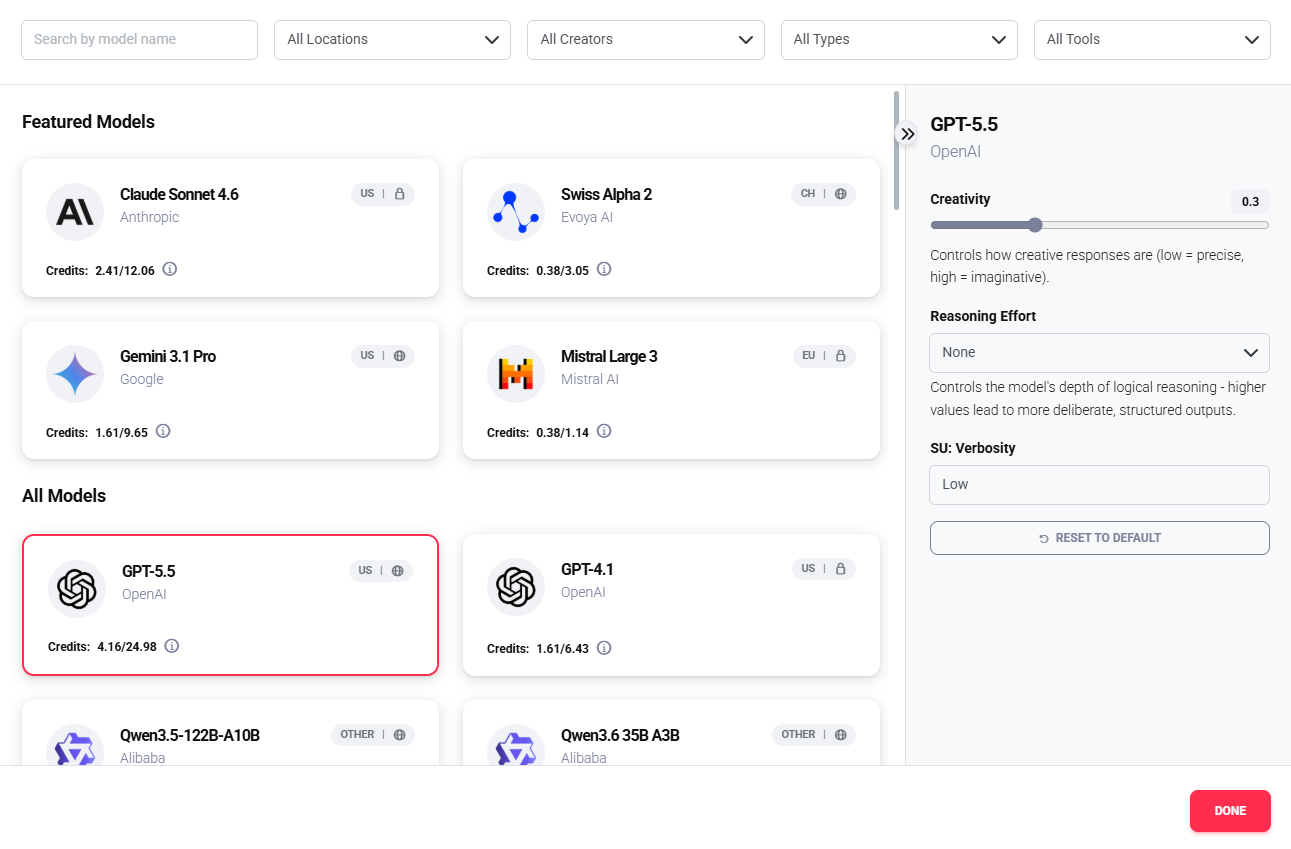
Creativity and reasoning
In addition to the AI model, you can further control the agent's behavior.
Creativity (temperature) influences how freely or strictly the agent responds. A low setting leads to more precise and consistent answers, a higher one to more creative results. The default is typically a medium value and suits most use cases.
For certain models, the reasoning effort can also be configured. This controls how intensively the model thinks logically before generating an answer. A higher reasoning effort leads to more thoughtful and logically sound answers, but also to longer response times and higher costs per request. This setting is particularly useful for complex analytical tasks or when logical reasoning is paramount.
Best practices
Choose the model based on the use case: for simple FAQ bots, smaller, faster models suffice; for complex advisory agents, a high-quality, powerful model is recommended; for special applications such as code generation, choose models with the appropriate capabilities.
Model change
Changing the AI model can alter your agent's behavior. Test changes before productive use.
Related topics
- AI Models Overview – Detailed information on available models